When the established sound field is diffuse (a field with the same sound energy density at each point in space), the dissipation of sound energy in an enclosed space takes place for incidence conditions on the boundary elements in all directions. This energy dissipation is translated by the sound absorption coefficient α of the material where the incidence in question occurs, this coefficient being defined, for each frequency f, or for the bands with center frequency fc, by the following relation: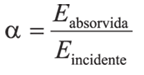
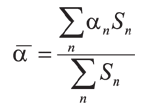
If the enclosure contour consists of surface elements, Sn , of different materials, we define the average sound absorption coefficient, for a given frequency, or frequency band, by the expression:
When a sound source starts operating in an enclosed space, the sound power it emits is greater than the power dissipated in the surroundings and in the air in that same space. This situation evolves to a permanent state where the sound power of the emission equals the power corresponding to the dissipation; otherwise the value of the sound power in the space in question would increase indefinitely.
Once this equality is established, the power dissipated in the boundary is composed of two parts one due to the first incidence (direct sound field), given by αW – where W represents the sound power of the source – , and another due to the n successive reflections occurring in the envelope, of value (1-αW),which constitutes the reverberant field.
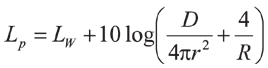
The sound pressure level can be calculated from the source sound power level Lw , with directionality factor D nd acoustic space constant R.