Resonant systems allow, by mechanical absorption, sound energy to be dissipated indoors and thus modify the reverberation time of enclosures. These systems can be subdivided into two types the resonant panels and the Helmholtz resonators.
Resonant panels (next figure) are extremely effective, and recommended, for correcting gaps in the low frequency bands when the distance from the rigid element (wall), where the porous systems should be placed, becomes too great.
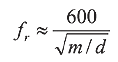
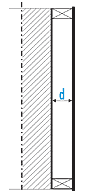 The expression for determining the resonance frequency fr of panels of this type, with surface mass m (expressed in kg/m2 ) and moved away from the rigid element by the distance d (in cm), is the following:
Resonant panels are efficient at the low frequencies of the spectrum, but suffer from the fact that they are very selective – as they are sized for a specific resonant frequency. To reduce the selectivity involved and to enable the panel to absorb sound energy over a wider frequency range, a porous material can be placed on its back, thus achieving a more extensive frequency behavior.
 The Helmholtz resonator is defined by an acoustic cavity (e.g. a bottle without a cork), or an analogous system.
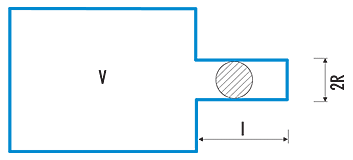
The incidence of sound waves on the inlet cross-sectional surface of the bottleneck imparts alternate displacements to the air mass contained therein, accompanied by energy dissipation due to the friction of the air against the walls of the bottleneck. A resonator is rheologically modeled by a mass-spring system with damping, where the air in the neck corresponds to the mass element, the air contained in the resonator body to the spring element, and the frictional energy dissipation mechanisms to the respective damping. Similarly, it is also possible to define a resonance frequency for this type of system, with volume V, straight section area of the “neck” S and neck length I:

This system is also selective in the frequency domain. However, this selectivity can be reduced by introducing sound absorbing material into the resonator body.


